

Editor's Note: I hope you have had the chance to catch some of the World Cup, because beyond the sport it is a rainbow of peace and diversity, bigger than the Olympics, the whole world cheering at once.
A storm came through this afternoon. I stood at the back door and watched the lightning flicker across the sky, that white crack that turns the whole yard bright for half a second and then lets it go. It does not ask whose yard it is. It lit the gardenias and the neighbor's fence and the old deck, all of it the same, all at once.
Something about an afternoon rain is tremendously peaceful. A cleansing, a restoration. You can even smell it in the air.
As I watched and listened, I found myself wondering when it storms here in Florida, does it bake somewhere else? Is there a natural plumbing kind of balance? The same atmosphere dumping water on the yard here is the one a man on the far side of the planet is probably sweating under. We share one thin skin of atmosphere, one set of oceans that have their own language, one churning system that has never known a line we drew on a map.
We are a species built by a single instruction.
Survive.
And do it by knowing who counts as us. First it was the tribe. Then the region, the city, the race, the sex, the flag. Every one of those circles was once a reasonable idea. Draw a line around your people and guard it long enough to draw the next line. The logic worked so well it went invisible, like breathing. And now it is the thing most likely to kill us, because nothing that can actually end us lives inside of a circle we create.
We have an ocean heating up. We have fisheries that need regulation to keep from collapsing. We’ve had viruses as long as man has moved the world over. They know no borders the same way the lightning doesn’t.
Here is the truth we understand more completely than almost anything, if we will sit still with it.
We are one thing. Not many things that ought to get along.
One thing.
Products of the same small planet, made of the same handful of elements cooked up and cycled for billions of years. There is no second source. There is no backup supplier. There is this one place and we are it.
You would not know it from how we act.
We treat the planet like a piece of chewing gum; good for awhile and then toss it away. There’s always another piece, except there isn’t.
There is a date every year called Earth Overshoot Day, and it’s coming right up. It’s the day that’s calculated where humanity burns through everything the Earth can regenerate in twelve months. It means we spend the rest of the year on credit, drawing down the principal, consuming at the rate of nearly two planets while owning one.
This is why the concept of borders is a political term but not a natural one. We look at a human being born a few hundred miles from where the good soil happened to sit, or the oil, or the rivers, and we call him an immigrant, a potential problem, a reflection of the ancient circle of protection.
It assumes that the scattering of resources across the globe were some kind of divine intervention instead of an accident of geology and a few centuries of who figured out how to extract, exploit, and trade first.
It’s why today some places are quite rich and some very poor. It is mostly a story about where natural stuff landed and who took it. It was never a story about who deserved it.
Instead of continuing the effort to assess how we can live better together, some of us have decided the smart move is to get to a Plan B.
It’s Mars as a lifeboat for the species, a second house we can wreck once this one is used up. I’m a fan of science fiction and science in general. It is perfectly plausible that our future will include more of the expanse that we have no ideas of at the moment. But when we talk about mining the asteroids (kind of cool, right?), it still seems strange to me we are ready to strip mine our solar system before we have learned to share our one planet.
In 1967 we wrote a treaty declaring that space belongs to all of humankind, the province of all mankind, that no nation may plant a flag on the Moon and call it theirs. We managed to imagine the out there as common ground, yet we cannot seem to manage it for the ground we feel under our feet. So if we look up, we have the vision of one people. Look down, and we are still a bunch of tribes arguing about who gets or takes the better pieces.
That is what we have so backwards. We have yet to truly appreciate our uniqueness and responsibility here. The next stage of our evolution is not going to be a faster rocket or a richer asteroid. Survival through identity must pass into ancestry, into the museum of things that kept us alive once but will destroy us now.
I have been reading Carlo Rovelli, Reality Is Not What It Seems, and I will admit most of the physics sails past me. But the part that lands needs no degree. We understand almost nothing about what we are or why we are here, and the closer we look the stranger and less solid the whole thing gets. The lazy move is to hand that mystery to religion, to let a story shut the door so we can stop being uneasy with the unknown. The braver move, and I think the only one that keeps us alive, is to keep looking. Keep chasing the understanding. And bring the spiritual with you into that chase, not as a substitute for it but as the thing that keeps us honest. Reaching for the infinite out there is no excuse for ignoring the obvious right here, and it’s in the rain and the ground beneath our feet.


Researchers built a microscope that uses AI to capture living cells in five dimensions, so we can watch disease unfold in real time. AI-powered 5D microscope captures living cells (The Brighter Side)
This is one of the strangest and most oddly moving uses of AI I have run into. A speaker that plays a living tiny world (mur mur)
Mysterious and baffling. A woman in London started hearing an unfamiliar voice that told her she had a brain tumor. Her psychiatrist called it the only case on record of a hallucination correctly diagnosing an illness no one had any reason to suspect. The voices that diagnosed a brain tumor (Live Science)
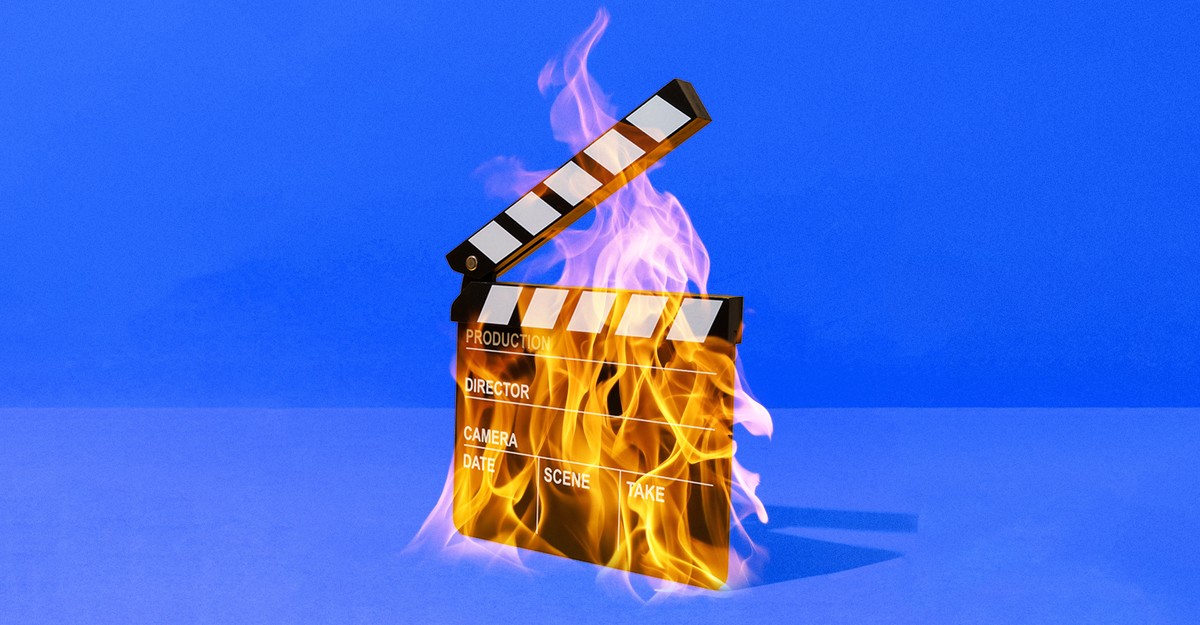
An Atlantic review this week goes after movies for cheapening us, and I could not disagree more. The critic misses the part that actually matters, the common bond. Star Wars fans are a worldwide phenomenon. Toy Story just handed its story to a second generation. Yes, there is garbage out there. I have never found the appeal of another Fast and Furious installment. But that is taste, not an indictment of the medium. Movies are just the newest branch of a very old habit, humans making things out of pure creativity and handing them to each other. Music evolved. Movies will too. What worries me is not the art form. It is putting a child in front of the wrong one too early. A good film finds the soul and stays there. That is not a flaw in the medium. That is the whole point of it. We losing sharing things together like a good film, we lose a part of our social being.

I will be honest, I did not do well on this one, and I suspect that is partly the point of a survey built to shrink education down to a number. We keep arguing about outcomes, about test scores and earnings and how it all feeds public policy and the quality of a life, and we keep missing the largest truth in the room. Education is the one thing, the only thing, that reliably moves humanity forward. Its greatest success was never only about a paycheck. It is the moment your mind cracks open, when an assumption you carried for years stops looking like a fact. It is learning that we share a big world of opportunities on a very small planet. You do not get there by measuring people against the fifteen mile radius you are most familiar with. You get there by widening the circle, breaking the circle, until the old certainties cannot survive inside it. While this survey points to public perception issues on education, we must be extremely cautious of undermining the power of a good well-rounded education to bring out the very best of us.

We will not escape future committee hearings and indictments. Nor should we. Focus will fall on Jared Kushner. His firm took billions from the Saudis weeks after he left the West Wing, and two Senate committees are already digging. The item that detonates will come from two rungs down. Someone unknown but involved. The shock will not be that they did it. It will be that they wrote it down, because it never crossed their minds that anyone would ask.
The next leap in energy is storage. Sodium-ion just made MIT's breakthrough list, a US startup is bolting grid-scale cells next to substations. The change will be a boring gray box in a neighbor's garage, cheap and safe enough that keeping your own power finally beats renting it. The cars bend too. But the real revolution is distribution. Electricity stops being something you buy and starts being something you hold.
They will tell you the Epstein story is winding down. In January the DOJ dumped three million pages and called it the last batch. Do not buy it. By their own count, two and a half million pages are still hidden, a report to Congress is still owed, and Massie and Khanna keep prying names loose one at a time. More will fall. The resignations already took a Goldman lawyer and a former Treasury secretary. They will keep coming. It was never one clean client list. It is the enablers, the lawyers and bankers and fixers who kept it running. That reckoning has barely started.
I am still away in Japan, and its a reminder that travel keeps doing what it always does. It lets the scales fall from your eyes. You stand somewhere far from home and the plain truth arrives quietly, that we are all the same everywhere, and it is only our systems that keep us apart. So keep reading, keep paying attention, and keep choosing to be good to the people in front of you. It is the smallest thing and the whole thing at the same time.
Always strive to be a good human.
Tell me how this issue landed
Tap an answer below. The second you vote, a comment box opens up, and I read every note that comes in.